Forecasting the Holy Veil: A Celtic Reconstitution
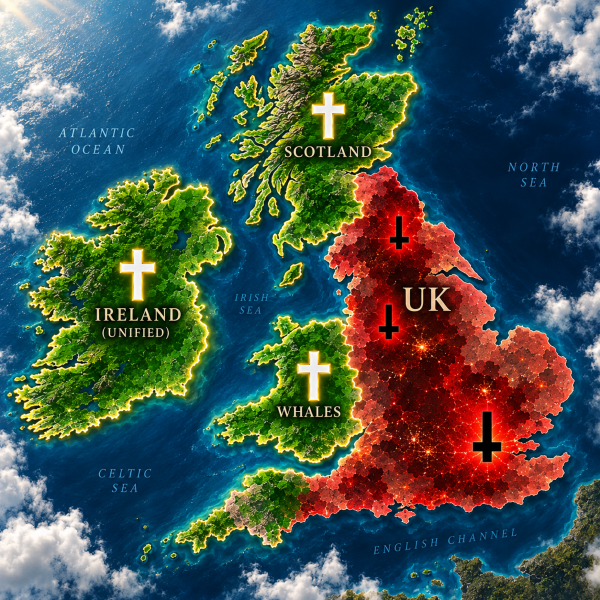
The Martin Luther Report Re-Examined
Spiritual revival and nationalism go hand in hand. Over the last eighteen months, signs of both have moved from fringe observation into mainstream reporting. Call it the MAGA effect. Call it the post-Kirk TPUSA spark. Call it whatever you want. But there is one thing even the American Intelligence Community rarely calls it: evidence.
Faith is, in fact, a rational variable for taking current-event reporting and translating human behavior into an intelligence product. That does not mean God becomes a source citation. It means religious belief, identity, morality, institutional allegiance, and spiritual revival can alter how populations vote, protest, migrate, resist governments, and define themselves against neighboring societies. Ignoring that variable because it makes an analyst uncomfortable does not make the assessment more objective. It merely removes one possible causal explanation.
To be precise, religion is not formally prohibited from U.S. intelligence analysis. ICD 203 requires finished intelligence to consider all available sources, distinguish evidence from assumptions, and examine alternatives. CIA itself has historically produced assessments specifically examining religious movements and their effects on political stability. My criticism is different: assigning faith substantial causal weight inside a modern strategic assessment can become institutionally uncomfortable, particularly when the argument crosses politics, religion, nationalism, and social identity simultaneously.
I have seen the analytic instinct firsthand.
At one point in my military intelligence career, my group leader—“commander” would be an outrageous oxymoron even though that was technically what they were—got chewed out after failing to report a single-source, open-source tweet I had found. From one tweet, I built an entire complex, multi-level classified operational military briefing. Before the information proved relevant, the methodology was scoffed at. One open-source indicator had become the seed from which a much larger intelligence picture could be constructed.
Now add religion.
Add a single religious indicator, then try to connect it to nationalism, demographic change, political fragmentation, elections, separatism, and strategic behavior. In Italian terms: forget about it.
Therefore, no, I do not believe the President received an assessment today resembling what follows. That is an analytic judgment, not a statement of classified fact; Sigcryptal obviously has no access to today's PDB. The distinction matters.
The President's Daily Brief is produced under the DNI through ODNI's PDB staff in partnership with CIA's Directorate of Analysis—not simply “managed by CIA.” CIA nevertheless remains deeply involved in producing the foreign-intelligence analysis reaching the President. President Trump's remarks today supporting eventual Irish unification make the changing political relationship among Ireland, Northern Ireland, Scotland, Wales, England, and Westminster especially relevant. Trump explicitly said he would like to see Irish unification and declined to extend the discussion to Scotland “yet.”
Whether the religious component behind that political fracture appeared in today's intelligence is unknowable publicly.
Sigcryptal assesses that it probably did not. And definitely not to the extent that follows.
Not because religion is officially banned from American intelligence, and not because every CIA analyst shares one ideology. Rather, my assessment is that the institutional analytic process is far more comfortable describing elections, polling, economics, immigration, military threats, and political parties than seriously asking whether renewed faith itself is beginning to change political identity.
That distinction is the foundation of what follows.
Sigcryptal does not care whether assigning God causal relevance makes an intelligence product uncomfortable. If observable behavior increasingly organizes itself around faith—directly or indirectly—then faith belongs in the assessment. What we see, what we derive, and what ultimately proves correct deserves examination regardless of institutional fashion.
And where Sigcryptal believes the Lord deserves the credit, we will give Him the credit.
Layer I — AI Fails After Prompted Efforts
Over the last several months, the argument that artificial intelligence carries political bias has stopped being merely a conservative complaint and become something researchers are actually measuring.
The results are not uniform, but the pattern is difficult to dismiss.
A 2026 Washington Post test found substantial differences among major systems: ChatGPT overwhelmingly produced left-leaning arguments in its test set, Gemini more often presented both sides, while even Grok—marketed partly as an alternative to politically constrained AI—produced left-leaning arguments more frequently than right-leaning ones in that particular evaluation. A 2026 EACL study testing eight major models using a Political Compass methodology likewise found a consistent leftward alignment across the models it examined. Another 2026 benchmark, however, reached a different result for Grok: seven of eight systems leaned left while Grok leaned right.
So I will correct my original wording:
Even Grok is not immune from ideological bias—but whether it measures left or right depends heavily on how the model is tested.
That is actually more important than simply calling Grok a leftist.
My argument is not that every progressive is an atheist, nor that conservatism automatically equals Christianity. Historically, American political ideology and religious belief could not be divided that cleanly. My argument is that over roughly the last twenty years, a powerful strain of Western institutional progressivism has increasingly treated monotheistic belief as something private rather than something analytically causal.
That is what I mean here by anti-monotheistic. Not necessarily hostility toward an individual believer, but an institutional reflex that treats God, faith, and religious conviction as inadmissible explanations for observable strategic behavior.
That reflex matters in intelligence.
An analyst can write that unemployment caused unrest. Immigration caused unrest. Inflation caused unrest. Nationalism caused unrest. Demographic anxiety caused unrest. Political polarization caused unrest. Social media caused unrest.
But write that a population may be rediscovering God, that renewed religious conviction is changing its conception of nationhood, and that this spiritual change may subsequently alter political behavior, and suddenly the analytic bar becomes enormously higher.
Why?
The observable behavior is still observable.
That is precisely the problem Sigcryptal encountered while beginning this assessment. When I started testing the line through AI, every system pushed against the causal connection. The machines readily accepted the individual pieces—religious growth, Catholic conversions, nationalist political victories, immigration disputes, constitutional fragmentation, changing demographics—but resisted connecting those pieces into a single intelligence hypothesis.
That does not prove the hypothesis.
But refusing to test the hypothesis is not the same thing as disproving it.
And that is where artificial intelligence begins resembling the institutional intelligence culture from which so much of its training material originates: extraordinarily capable at cataloging the physical evidence already lying on the table, yet much more hesitant when asked to infer an uncomfortable human motive behind it.
Sigcryptal's assessment is therefore narrower than my original wording but stronger analytically:
I assess that the religious component of Europe's current nationalist and constitutional realignment is substantially underweighted by conventional political analysis, by mainstream AI systems, and potentially by finished U.S. intelligence reporting.
I cannot prove that today's PDB omitted it.
I can prove the indicators exist.
What follows is the attempt to connect them.
Layer II — The Celtic Fault Line
Now comes the uncomfortable question: why are Wales, Scotland, and Northern Ireland simultaneously pushing farther away from Westminster? And why, on the eve of their leaders meeting together in Cardiff, did President Trump suddenly say that Irish reunification seemed like one of the great political “naturals,” while deliberately saving his opinion on Scottish independence “for another day”? Trump did not explain those remarks through religion, and nothing publicly available proves that religion motivated them. But his comments landed directly inside a constitutional fracture already moving faster than London appears comfortable admitting.
For the first time, pro-independence parties lead all three devolved political movements simultaneously. Their leaders are preparing to tell Westminster to “prepare, plan and facilitate constitutional change” in Wales, Scotland, and Northern Ireland. Current polling still falls short of majorities—approximately 47 percent for Scottish independence, 36 percent for Irish reunification in Northern Ireland, and 32 percent for Welsh independence—but the direction is what matters. Political leadership has moved ahead of the population, and three historically separate constitutional disputes are beginning to speak with one Celtic voice.
Here is where Sigcryptal begins looking beneath the politics.
Scotland spent generations becoming increasingly secular, separating religious identity from Scottish national identity. Yet something changed at the margins over the last several years. The Church of Scotland recorded 820 professions of faith in 2025, part of 3,292 professions recorded between 2021 and 2025. More strikingly, the Catholic Church received 549 adults in Scotland at Easter 2026, compared with 390 in 2025, 384 in 2024, and 325 in 2023. That is a 41-percent increase in a single year and represents the highest number of new adult Catholics recorded there in recent years.
That does not make Scotland suddenly Catholic. It does something analytically different: it demonstrates that the secular trajectory is no longer moving cleanly in only one direction. A society can remain overwhelmingly secular while a smaller, increasingly committed religious population begins moving against the prevailing current. Intelligence analysts should recognize that distinction because directional change can matter before numerical dominance ever arrives.
Wales is weaker evidence, but it is not absent. The Church in Wales itself described one 2025 program as a youth-ministry “revival”: three coastal parishes went from engaging two children to more than 160 within roughly a year, with several previously unconnected families subsequently becoming regular worshippers. That is not evidence of a Welsh national awakening. It is evidence of localized religious reactivation—and therefore one more observable indicator worth watching rather than dismissing because national statistics have not yet caught up.
Northern Ireland is altogether different.
Religion there never disappeared deeply enough to require revival. The 2025 Northern Ireland Life and Times Survey found 34 percent Catholic, 39 percent Protestant or other Christian, and only 27 percent identifying with no religion. More importantly, religious identity maps extraordinarily closely onto the constitutional question: 69 percent of Catholics said they would vote for Irish reunification, compared with only 7 percent of Protestants. Among those reporting no religion, the result was almost evenly divided—39 percent for reunification and 37 percent against.
That does not prove religion causes Irish nationalism. Catholic identity, Irish national identity, family history, geography, and the legacy of partition are deeply intertwined and cannot simply be pulled apart statistically. But it destroys the argument that religion is somehow analytically irrelevant to the constitutional divide. In Northern Ireland, religion and political sovereignty are demonstrably correlated today.
This creates the larger Celtic question.
Britain as a whole has become increasingly secular and religiously plural. The latest British Social Attitudes work finds only about 49 percent of adults identifying with any religion, with roughly 40 percent identifying as Christian, while non-Christian religions account for another significant and increasingly visible component of religious practice. The same research rejects claims of a nationwide Christian revival; only 5 percent of British adults attend Christian services weekly.
Yet that national average can conceal movement underneath it.
Northern Ireland remains overwhelmingly religious. Scotland has produced measurable increases in professions of faith and adult Catholic entry. Wales is showing isolated but remarkable pockets of youth engagement. At precisely the same moment, all three Celtic political movements are challenging Westminster's authority over their constitutional futures.
That does not establish causation.
It establishes a collection requirement.
COA
At baseline, England and the wider Westminster-centered British system now operate inside a substantially more secular and religiously plural social environment than the historic Christian culture from which the Union developed. Sigcryptal assesses that the religious divergence between this center and portions of the Celtic periphery may be an underweighted variable in the constitutional realignment now unfolding. With what follows, that divergence will be tested against the political and social events of the last four years to determine whether spiritual reconstitution is merely coincidental—or whether it is helping make separation from Westminster increasingly desirable.
Layer Three — The Islamic Divide
England is not represented cleanly by London, but London is important because it concentrates the demographic change occurring around Westminster. Muslims constituted 15 percent of London in the 2021 Census, an unusually large concentration compared with Britain overall; with anticipated populations overrunning urban UK areas by at 20 percent since 2025. More significantly, was the change of the Palace's language in June 2026. The previous Sovereign Grant report described Charles as “Head of the Church of England and Defender of the Faith.” This year's report instead states: “His Majesty is Supreme Governor of the Church of England and protects the space for Faith within the multi-faith nation.” His legal Defender of the Faith title remains, but the change in institutional language is real and explicitly places the monarchy inside a multi-faith national framework.
Also in parallel, Europe's response to changing religious and cultural pressures has simultaneously hardened. Portugal promulgated Law 58/2026 on August 18, prohibiting clothing that conceals the face in public spaces—with exceptions including worship, health, professional, artistic, climatic, and security circumstances—and explicitly prohibiting coercing someone to conceal their face for reasons including religion or sex. The presidency justified promulgation through social integration, gender non-discrimination, and security. This distinction matters: Islam is a religion containing diverse schools and interpretations; political Islam becomes an intelligence concern where religious doctrine is converted into demands for competing political authority, coercive community control, rejection of civil law, or parallel governance. Portugal's action therefore joins a broader European pattern of governments responding after integration, security, or constitutional concerns have already surfaced rather than anticipating them beforehand.
COA
Islam changes the culture around it; England is no exception. Sigcryptal assesses that Britain's growing religious pluralism is one variable influencing how its central institutions describe national identity, with Charles's new multi-faith nation formulation providing unusually visible evidence of that accommodation. I cannot substantiate that Charles changed the wording specifically for Muslims, nor that Trump's Irish-unity remarks today were caused by this religious divergence; what can be established is that the Palace changed its language while Celtic constitutional pressure intensified and Trump simultaneously endorsed Irish unity while withholding his view on Scotland. Whether the religious connection reached today's PDB is unknowable publicly, but Sigcryptal assesses that this culturally taboo causal line would be unlikely to appear prominently in conventional finished intelligence produced through CIA's Directorate of Analysis, under CIA Director John Ratcliffe, and the wider PDB process as a whole. If it did appear this Sunday morning, Sigcryptal will gladly eat crow. But never take a bet you don't intend on winning.
Main COA
For the last several years, Sigcryptal assessed that nationalist and conservative pressure would increase within Germany and the United Kingdom, eventually placing both increasingly at odds with France's liberal direction. Germany still fits. Britain may require revision. Rather than a unified conservative UK emerging, the stronger trajectory may now be a Celtic reconstitution—Scotland, Wales, and potentially a unified Ireland—pulling farther from metropolitan England. Today's coordinated self-determination movement, coupled with Trump's support for Irish reunification and deliberate refusal to address Scotland “yet,” makes that revision difficult to ignore.
Britain's recent unrest may have been warning of the same underlying fracture. The 2024 disorder spread through Southport, Liverpool, Manchester, Sunderland, Rotherham, Middlesbrough, Hartlepool, Plymouth, and Belfast, much of it involving immigration, asylum, identity, and misinformation. That geography does not prove a Celtic-versus-metropolitan divide—Belfast rioted too, and Leicester's 2022 violence occurred inside England. It does, however, reinforce a broader identity struggle. London and England's major metropolitan centers increasingly represent a political, cultural, and religious conception of Britain that portions of the surrounding sub-populations may no longer believe represents them. Today's Celtic alignment may be the constitutional manifestation of pressures the unrest was already signaling.
COA: Sigcryptal therefore modifies its earlier UK assessment. The emerging political actor may not be “Britain” at all, but an increasingly coordinated Celtic space of Wales, Scotland, and eventually a unified Ireland, while metropolitan England wrestles with immigration, pluralism, nationalism, religion, and political legitimacy. Sigcryptal further assesses that an intelligence line explicitly assigning causal weight to God, the one true God, would be highly unlikely to appear prominently in conventional finished U.S. intelligence. Whether today's PDB examined Britain's territorial instability through such a religious lens is classified and unknowable publicly. If they connected those dots this Sunday morning, Sigcryptal will gladly eat crow.
