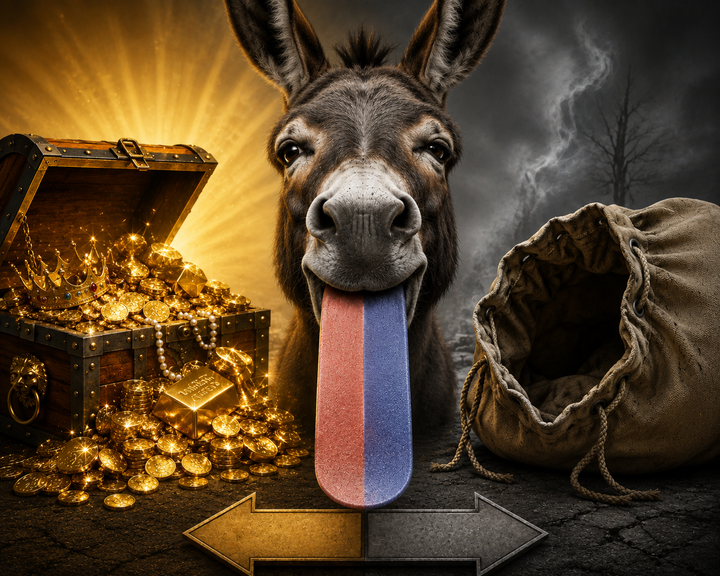
Oracle of Omaha's Ghost Never Quits

Within the last year, a truly great legend retired from the world of investment: Warren Buffett. The Oracle of Omaha built an enterprise and became one of the best investors of all time by sticking to one fundamental rule: tangible commodities. Even when AI was taking off, Buffett doubled down on tangible, commodity-based assets. He rarely chased the cards, but always doubled down on common sense. However, that is not always the wisest investment strategy because it seldom capitalizes on speculative returns. Managing a balance between hype and solid investment portfolios is most ideal.
On the other hand, Trump always doubles down on the intangible assets at hand. Mostly driven by the glamour of the times, Trump has often been influenced by the wrong people of late. To quote Trump himself, in March of 2025, Trump touted the Stargate deal with Japan while also putting down his own investments: "I have no idea why AI is so popular, but it is, so we are doing it." During that one quote, he actually looked off-camera to his advising team. At that critical point in history, Trump himself did not even understand why or what his advisors were telling him.
So What?
The major impact of Trump's recent words on 13 August 2026 should raise red flags: 'data centers could be bigger than oil'. Is that so, Mr. President? A real estate genius became an expert on today's tokenomics? I don't buy it!!! Once again, his advisors are feeding the wrong information into his ear. If anything, it's a little naive and dangerous to make this comment without solid facts.
Situation:
- Abbott has been primarily concerned with the Texan electrical grid.
- Texan politicians have greenlit some of the most advanced nuclear mining projects in the nation over the last two years. They have heavily optimized fracking using AI and are also ramping up oil-site production.
- Since DEI-era policies, over 100+ Fortune 500 companies have moved their headquarters to Texas.
- Over the last month, Texas has opened a domestic stock market. This effort is the first of its kind in decades.
- Local communities tend to be strongly against new data center builds, especially for the AI boom, because they steal local resources. Most of the time, these local power grids are overtaxed, or worse, subscribed for without due repayment over time. Enough water is also a concern. Depending on the data-center setup, it's possible to exploit local water resources without community benefit. Just look at Romania on 13 Aug; they had to shut down their nuclear reactor because of low water levels. This was the first time Romania did this since 2003ish, and is reflective on some data center operational requirements.
- COA: Abbott is struggling to ramp up resources (water and electricity) to both support his constituents and newly found company headquarters. Even though these companies are willing to front the cost of these necessities, the short-term hurt exposes gaps in political support. This comes at the worst time for the Republicans, and it is strange why Trump is pushing this direction publicly so hard. The Ohio race is indicative of Abbott's situation. As of yesterday, Fox News released poll guidance demonstrating that Trump's push for long-term investments are driving independents away from GOP candidates. Also mentioned in an earlier assessment, failure for JD Vance to ensure post-MAGA Republican endurance, particularly in Ohio, will sorely reflect on his 2028 Presidential aspirations. Therefore, it is likely that current evidence supports that Trump is being misguided for long-term success over critical short-term hurdles, both for political derivatives and for American short-term financial stability. This doesn't reflect the proposed quantity of builds in Texas, but instead urges the President to consider external advisement for more realistic, targeted financial investments in emerging technologies.
- COA: Another factor, and one that was alluded to earlier, is that short-term hurt actualizes into long-term suffering if the status quo changes. It's easy to look back five years from now and say, "That was a no-brainer"; however, Trump's argument is not as sound as originally laid out. For instance, today alone the Conversation posted an article on the significant hidden costs undermining AI return on investment (ROI) gains. Their article will bolster claims made later within this one, such as that the AI token hype does not meet valuation expectation. As Buffett would've pointed out, their commodity valuation does not align to it's tangible fundamentals. Instead, the hype has lead to unrealistic ROI gains and volatility that will create shaky actualized power.
Looking at it differently:
- In about 365 days, in between pushing his agendas, fighting wars, and getting his folks in office, somehow Trump went from clueless to an expert on tokenomics, or the commodity-based association with Large Language Model (LLM) accounting. Unfortunately, there has been several instances of token valuation emulating an extremely speculative and volatile commodity. Over the last year alone, I would argue that LLM tangible assets have depreciated faster, and were more volatile, than any e-currency-based model.
- COA: Even though GPUs depreciate faster than any other tangible asset on Earth, that is not the true problem associated with tokenomics financial predictions. During Trump's meeting at the start of August, he and his advisors learned information that made token-based valuation extremely volatile.
- COA: It is not the responsibility of the President to be a Subject Matter Expert (SME) on every topic; that's where his advisors come into play. Unfortunately, his advisors knowledgeable in tokenomics seem to undervalue the true volatility of the market, and instead are dazzled by pretty ROI numbers provided by lobbyists.
Going Forward:
- COA: Texas, led by Abbott, is highly likely to accommodate the rapid corporate fluctuation by blessing permits to build these data centers over the next year. It is also likely that these permits will be few and far between until closer to, and possibly after, the midterms, since new data-center builds are an extremely sensitive issue for voters.
- COA: Looking into shared commodities owned by regulators and operated by the industry may be a better hedge against tokenomics side effects (rapid devaluation). Unlike what the WH advisors suggest, ideas which are sponsored by lobbyist desires, such a business model may in fact be decentralized in Texan oil lands. If that model is not digestible, it's possible to sponsor an industrial-backed source to target directly at off-county locations. Finally, it's not unheard of to export tokenomics to other built up states during the transition period. This would also mitigate short-term political ramifications.
Overall:
- Trump needs to focus not on what the BlackRocks of the world are telling his advisors, but instead on what truly are the risks associated with our generation's new commodity market.
- Buffett would have been a strong proponent of data-center strength and location versus solely focusing on AI's perceived influence. Without considering how to effectively own and leverage tokenomics per industry, the WH continues to be behind in policy to action. I would argue that this failure to connect realistic commodity volatility and ROI gains is hindering Trump's ability to even get GOP members to back his plan. Furthermore, it is affecting future political careers of those whom choose to be ignorant in the subject (ex. Vance). The Oracle of Omaha always knew how hype and accurate valuation accounting contributed to crisis alpha, and also, he know how to leverage this. Trump should invest the time and energy into understanding Buffett's tried-and-true process. Failure to do so will result in continued friction among his own ranks.